Showing posts with label sustainability. Show all posts

Monday, May 4, 2015

Thinking. Learning and Living Sustainable

Upon descending from the steep hike of the Highland Fruit Tour on our second day in Costa Rica, it wasn't only witnessing the amazing views that truly left an impact on me. Jonathan, a local guide and entrepreneur, gave us a tour of the small town in which he lived as well as his inside account of what it means to be a part of the community in Los Santos. Jonathan, who owns his own brand of locally produced and eco-friendly gourmet Costa Rican coffee, began to stress the importance of sustainability in his world high up in Talamanca Mountains. The passion and belief in which he spoke of giving back to his community and creating a better world is not something easily forgotten and has created a lasting impact on my life. He discussed the efforts of the local farms that provide food to the town’s elementary school and his push to give tourists a hands on experience in helping the community. Witnessing one man doing so much to give back to his community is truly inspiring and something we should all take note of. The impact that it left on me was certainly enough to make me rethink how sustainable I live.
Highland Fruit Tour
            Out of all the excitement and ambition that Jonathan holds for himself, he doesn't expect everyone to start an eco-friendly business or to feed a whole school with local produce. Rather, he expects everyone to play their part on an individual level. Bettering ourselves in a way that betters our communities and environment is something that falls on the shoulders of the individual. Personally, I have worked on changing just a couple of my habits in order to become a more eco-friendly individual: Turning the light off when I leave the room, reusing my towel after showering, choosing the local option instead of the name brand, being conscious of my plate size to not waste food and recycling are all examples that everyone can do to better our environment.

Group picture with Jonathan!
            Fortunately, I was able to participate in this life changing opportunity in which I was able to see and learn what it means to be truly sustainable first hand. In Costa Rica, sustainability is more than just a practice, it is a way of life that the country would surely suffer without. Unfortunately, not everyone in the U.S. has the opportunity to learn the true importance of a sustainable society. The most important element in creating this sustainable community is in the education of its individuals. I believe it is time for our communities to learn from the practices that Costa Rica is showing the world. We all have the opportunity and resources to live responsibly and by following the lead of people like Jonathan, we can certainly raise the expectations we have for ourselves as a community. 

Pura Vida!

-Billy Carroll

The Energy Team: Renewable is Sustainable

Travelling to Costa Rica this past January was a unique and transforming experience for our class.  Some had signed up because it involved going to Costa Rica and others were using it towards their major, but none of us had a full grasp of what it meant to be sustainable in our everyday lives until this trip.  A common question asked is “What is sustainability?” A common answer usually has something to do with going green, saving power, and something about a ‘carbon footprint’ or ‘greenhouse gasses’.  In Costa Rica, we learned that being sustainable is much more than that, and it is much easier than we think, as long as we put some time into it. 
 
During our visits to various hotels, coffee farms, and other sites, our group focused on learning all about the energy used to power life where we were.  We started off in the HiltonDouble Tree Cariari hotel in San Jose, Costa Rica, where we had our first look into the Costa Rican reality.  One of the first things that our group noticed was the open air that the restaurant had, as the front lobby was always open to the parking lot and there were no walls or doors between the ‘indoor’ areas, such as the dining area, lobby, and lounge, and the ‘outdoor’ area, which consisted of a patio and pool.  This eliminates the need for the hotel to have temperature controls in its public areas as the temperature is simply controlled by the weather outside.  Another thing that we had noticed right away was that our lights didn’t go on by simply turning on the switch.  In order for power to go to the lights, the room key had to be stuck in the slot on top of the light switch so that the hotel wasn’t wasting electricity on lights being on when no one was in the room.  Lastly, we also noticed that none of the rooms had a refrigerator in them, which was common in every hotel.  While it is normal for a hotel in the US to include a mini-fridge, in Costa Rica it is seen as a waste of energy, as it is running all of the time, whether there is someone staying in the room or not and whether that person is using the appliance or not.  Even though some of us viewed this as a slight inconvenience, we quickly forgot about it and a refrigerator wasn’t even on our minds by the end of the trip.
 
Another notable hotel that we stayed in was the Laguna Lodge in Tortuguero, a town that can only be accessed by boat.  This town is interesting, as it is small, there are no automobiles, and it relies on the mainland, about a two hour boat ride, for many resources, such as gasoline, electricity, and waste disposal.  However, they are very efficient in using what they have.  First, there are not many things that
are powered by gasoline.  There are several four-stroke boats that are used for transportation to and from the mainland for hotel guests and employees as well as boats to carry waste from the town and bring other resources to the town.  Tortuguero is very self-sufficient, despite being an island.  The hotel that we stayed at was very open, having no temperature control in any of its buildings, including the bedrooms.  Instead, there were screen windows in the front and back that were could be closed with wooden shutters at night.  In addition, the top of the building, the last foot before the ceiling, was also an open screen, ensuring airflow even if the windows were closed.  The only sort of temperature control available was a small rotating fan on the ceiling to circulate the air.  In addition, the entire town of Tortuguero receives its energy from a power plant on the main land that provides electricity via hydro and geothermal power.  The cool part is that the electricity is transported to Tortuguero using the same kind of electricity wires that we use in the United States to run power from our non-renewable energy plants.
 
The last hotel that we stayed in was La Quinta Sarapiqui, which has a five leave certification, the highest rating of sustainability in Costa Rica given by the CST.  This comes at an expensive cost, but it is all worth it when their environmental impact is considered.  One of the things that this hotel has done is replace every light bulb that they have from the regular, inefficient bulbs, which cost about USD$0.50 per bulb, to low voltage, energy saving, more sustainable bulbs, which cost about USD$10.00 per bulb.  While this is an expensive cost, it is traded with the ability to use less energy and have less of an impact on the environment.  In addition, La Quinta Sarapiqui also has an open-air concept, with a walk-in lobby, pool, dining area, and even outdoor private patios for each room.  One of the things that the owners were very proud of is their new biodigestor, which costs about USD$30,000.  It had taken them a long time to acquire, but they are now able to use this to further their sustainability even more.  They are looking to invest in more sustainable energy in the form of solar panels in the future, but due to the expense they are unable to fund the project for a couple of years.
 
In addition to the hotels, we visited restaurants, coffee farms, and other places to see their sustainability efforts as well.  One of the favorite sites that we visited were the Tabacon Hot Springs, a popular tourist attraction that uses solely geothermic energy from the volcano that is sits on, with the exception of a gas generator to power the buildings in the rare case of a power outage.  Nuestra Tierra, a restaurant that we ate at on our first day, had an interesting energy saving technique; the meals were served on banana leaves instead of plates.  This genius idea not only helped save the company money on plates and dishwashing, but it is very sustainable as well.  Not only are the banana leaves reused as fertilizer when they are done, but they also eliminate washing dishes, not  
only saving water, but also saving electricity that would be used to run the dishwasher.  Finally, we also noticed that many of the coffee farms roasted only a portion of their coffee, as it takes a lot of energy to do so.  However, the coffee that they did roast wasn’t done unsustainably; most farms use the unused shells to help fuel the roasters, as to not use a lot of other resources to roast the beans.  This not only helps preserve energy, but also makes for better tasting coffee.
 
Using what we learned in Costa research, and by doing some outside research, our group has come up with ideas to help Bryant University become more sustainable.  There are some simple suggestions that we have which include turning off all lights, TVs, computers, and other appliances and electronic equipment when they are not in use.  This will greatly reduce the amount of energy the university uses, thereby also saving money on utility expenses.  In addition, if Bryant students switched from using disposable plastic bottles to reusable water bottles, not only will it reduce waste, but the energy that it takes to produce a disposable bottle is 10 times more than the energy it costs to produce a recycled reusable bottle; changing this habit would not only be cheaper but it would also help reduce the footprint, not just from Bryant, but from all over.  Bryant students, faculty, and staff can help by spreading this information, asking their friends to start using reusable bottles, and we will be able to see the production of disposable bottles decrease and save energy.  This is a small change that Bryant can promote into become a large change in the community.  Some other large changes for Bryant can include solar, wind, or another feasible type of renewable energy to power the campus as well as investing in renewable energy for the entire community of Smithfield.
 
We also did some research on Aramark, Bryant’s dining services provider.  While Aramark has many green initiatives, there are ways for the company to become more sustainable on campus.  First, new equipment in Nick’s Place will help reduce the energy used in cooking and preparing food throughout the day.  In addition, we have suggested that Aramark split Salmanson Dining Hall into different lighting zones so that lights can be turned off in sections that are not being used during slow periods, such as long weekends.  Finally, we came up with a big suggestion for Aramark to make a long-term impact on the school; we suggested that Aramark can start the process of putting renewable energy on campus by investing in a solar panel system or other feasible renewable energy source to power the food service areas.  This will really showcase Aramark’s commitment not only to Bryant, but also to being a responsible and sustainable company. 


--Energy Team: Daniel DiNicola, Ethan Agnello, Krysia Syska, and Eaindra Aung

Sunday, May 3, 2015

Pura Vida


I don’t believe that any of us were ready to return to the United States after spending over a week in Costa Rica. To some extent we all had ‘Costa Rica Fever’ (some more literally than others) and unfortunately we did have to say goodbye to all our new Tico friends including crowd favorites Miguel and Juan-Carlos.
We brought back a lot of things with us, both in our suitcases (……Dr. Boyer and Dr. Attaran) and in our minds. The genuine people we met, the adventures we went on, and the places we visited truly allowed us to adopt a very authentic interpretation of ‘sustainability.’
As many of us have stated, we absorbed a lot of information in Costa Rica about sustainability that has greatly impacted the way we live in the United States. I fully support and believe this statement as well, but I think there was a lot of things we learned about ourselves and our peers that we should not forget.
It took them 10 minutes to jump...
Dan, my roommate and Energy Team member, managed to find his way to the top of the mountain  with the support of Jonathan and our classmates, for which we applauded upon his arrival at the peak. Autumn and I taught each other how to get the best GoPro footage for every activity (mounts, resolution, frames per second….it’s a GopPro thing). Billy recognized that it’s not always about the booty when we danced the salsa; he found that his hips don’t lie either and he would give Shakira a run for her money. Eaindra is the best scribe at Bryant; I frequently caught her taking notes in every possible scenario which is why Eaindra will be any group’s biggest asset next year at Bryant (Juniors pay attention to what I’m saying for BUS 400). I was able to help a friend discover a passion for animals (Yes, Ronny that’s you…..SLOTHHH), witness Emily discover new go-to dances, and convince two college professors to jump off a cliff (there was water 20 feet below). Krysia loves the beach but may soon have a coffee addiction, Jake and I bonded over things that make us mad, Marco appreciates the simple things in life that are often overlooked, and I often found myself eager to hear Kasey’s contributions when we reconvened as a class for discussion nearly every evening. Among many other things, these are some of my most valuable takeaways from the trip.
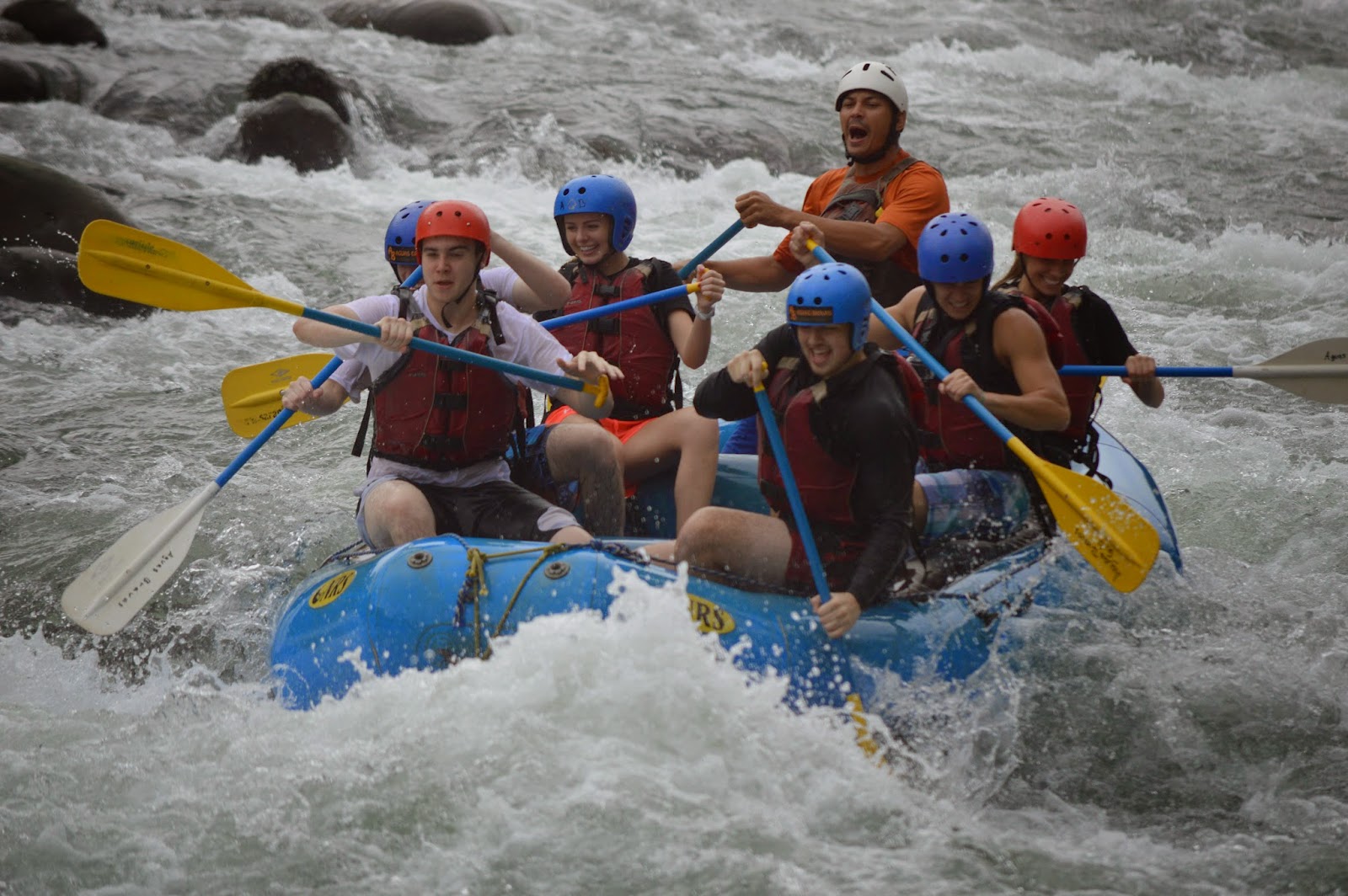
I just wanted to thank everybody on the trip for being a good team: this means pulling each other out of rapids, pointing out monkeys in the trees when nobody else could see them, taking pictures for each other, prioritizing who gets the bathroom first during much needed breaks, and voluntarily spraying each other with bug spray to ensure full coverage. Let me know where we’re going next, I’m in.
-'Etan'

Back in the United States!

Costa Rica was the experience of a life time.  Sustainability Marketing 421 is a tremendous opportunity that goes way beyond what students can learn sitting in a classroom.  This class allowed our small group of students to make farms, coffee plantations, recycling plants, the rainforest, and more exotic locations our classroom!  This class gave students the opportunity to learn about sustainability practices from people who live a lifestyle of sustainability in Costa Rica.  This class provided me with a learning opportunity but also allowed me to change the way I live my life on a day to day basis once experiencing how Costa Ricans live in person.
Fruit demonstration during our Highland Fruit Tour.
Being back at Bryant, I have attempted to change the way I live as well as influence others. Before going to sleep or when leaving my suite, I always make sure that all lights and appliances are shut off.  In addition, I have reduced the amount of food I take at Salmo, to reduce my own personal food waste.  I also reuse plates and cups at Salmo to reduce the amount of soap and water needed to clean more dishes.  While walking around campus, I make sure to help others be sustainable as well.  I have described my experiences in Costa Rica to others in an attempt to gain awareness for environmental issues.  I also love yelling at people to recycle when my friends get up to throw something away.
 I have also noticed the current sustainability efforts here on campus as well.  There are many organizations on campus here at Bryant who try to implement change on campus.  Aramark, Bryant’s food provider, also does a lot to promote sustainability.  Aramark weighed food waste one day for example, illustrating to students how they can be more cautious to help the environment.  Aramark also separates paper for compost.  There are signs all over Salmo which discuss sustainability issues as well.  This class was helpful because it allows more Bryant students to get involved in this change occurring on campus.

BryantMkt421 students learning about the coffee process.
Finally, this class was just plain fun.  This class allowed me to experience some once-in-a-lifetime activities, such as zip lining through the rain forest in Tortuguero, relaxing in natural hot springs with hot water sourcing from a volcano, and whitewater rafting with the beautiful scenery of Costa Rica.  This trip allowed me to learn, have fun, and bond with a group of Bryant University students and faculty for a life changing experience that I will never forget.  This course should be number one on students’ lists when registering for classes.  Sustainability is a topic that compliments business majors.  Sustainability practices are being adopted by a majority of companies in an attempt to create respectable business ethics.  I personally promise that taking this course will change your life and help you stand out when pursuing an internship or job.  Pura Vida


BryantMkt421 students learning about sustainability with our tour guide Jonathon.

-Ronald Wagner


Whitewater rafting! #TeamHorsePower

Saturday, May 2, 2015

Food for Thought


Our first meal at Restaurante Nuestra Tierra
It has been almost five months since we were in Costa Rica and I still haven’t found a meal to match our first lunch in country. One of the biggest things I miss is the meals of rice, beans, and protein. The rich taste of all of the foods is hard to match back home. It speaks loud volumes to the difference in local and natural foods. After eating and touring at Don Juan's farm and seeing food go from farm to table showed how important that supply chain for food is. Using sustainable practices such as natural fertilizer or using solar panels to power hot water can really change the mentality of the farm. You can taste difference in the meal than if you got ingredients from a supermarket.


This is one major thing I took away from Costa Rica is the passion the Ticos have for their jobs and sustainability. Sustainability is second nature to them. While in some areas it is not a choice, it has become a social norm where as in the USA that is not the case. It is inspiring to see the passion they have towards their country and their jobs.

The recycle room at La Quinta
I learned a ton from my group, hotel sustainability. The most inspirational was La Quinta, no not the famous chain. The 5 CST leaf level hotel who the lovely couple Leo and Beatrice own. They have worked 22 years to earn this rating. By doing things like investing to preserve the once orange plantation and support the local economy. They use solar energy and an intense recycling system. The owners take tremendous pride in their sustainability efforts and their ability to provide customers with incredible hospitality.

While our group has been become more environmentally cautious but the biggest take away I gained from this trip was how seriously companies take the green movement. In Costa Rica it is a social norm but here it is a marketing tool. These companies make it their mission to be sustainable and give back. It is an inspiring thing to see and has forced me to see business in a different light. 

This one in a life time trip has taught me valueable lessons and gave my unforgettable memories with a great group of friends. Thank you for following our twitter and blog. I hope you enjoyed it as much as we did. 

Our view from the Highland Fruit Tour


-Jake Lamar
@jakelamar29
 

Thursday, April 23, 2015

A Sustainable Future


Costa Rica was an eye opening experience for me and the results were life changing. Prior to the trip my knowledge of sustainability was narrow and limited to just recycling bins; now I can grasp a full understanding of not only the broad aspects of sustainability but the significant impacts it has.


It is important to fully understand the need for and impacts of sustainability practices, especially from a business perspective. Profit-driven businesses often lack sustainable practices. Learning about some of Costa Rica’s businesses and how they coup with the extra efforts despite the additional costs was inspiring to me. I also now make it a point to support local farmers and businesses that source locally, by not only providing them my business over competitors, but also promoting their sustainable efforts through social media.
Learning the importance of sustainable practices through our adventures has inspired me to make small daily changes as well, such as: shorter showers, wearing some clothes twice before washing to decrease load size, using natural light more often than electrical, never wasting food, carpooling, and just always being conscious of things that are on and not being used. Hopefully one day when I have a place of my own I can become even more sustainable and incorporate composting, personal gardening, sorted recycling, and who knows maybe even potential wind or sun powered energy.
I definitely miss the beach and the sun but the places we visited and the people we talked to have changed my perception of sustainability, teaching me lifelong values for a better tomorrow.  
Don’t forget to follow us on Twitter @BryantMKT421 to learn more about our adventures and how you can improve your sustainable practices and preserve our beautiful planet. Pura Vida! - Krysia Syska


Monday, January 26, 2015

The Local Catch


During our adventure to the Pawtucket Farmer’s Market I stumbled upon The LocalCatch among many other fresh seafood alternatives. The Local Catch is a local Rhode Island seafood processor and wholesaler that markets local seafood to local consumers. The Local Catch Inc. was founded in 2010 by 30-year fishing veteran Captain Richard Cook (Left) and his wife Ann. Together, Rich and Ann continuously support New England fisherman by providing the freshest, highest-quality seafood to local markets. This sustainable practice stimulates the economy and allows local commercial fisherman to stay in business by capitalizing on Rhode Island’s natural seafood resources. After a brief discussion with Captain Rich himself, it became very apparent that he was knowledgeable of the industry, specifically: what to catch, where to catch it, when it’s in season, and how to keep it fresh during transport. Captain Rich also mentioned the success of a recent addition to The Local Catch - fresh seafood deliveries. Customers can place orders for seafood to be delivered right to their doorstep on thelocalcatch.com. Furthermore, customers have the ability to opt into a weekly e-newsletter that elaborates on the weekly catch, what seafood is in season, and recipe recommendations used by Rich and his community of local fishermen.
Learn more about local contributors to the Pawtucket Farmer’s Market and about our upcoming trip to Costa Rica on Twitter @BryantMKT421 or on our semester-long blog at http://www.bryantmkt421.blogspot.com/.
 

Thursday, January 22, 2015

Tirimbina Chocolate Tour

In Sarapiqui, we visited the Tirimbina Rainforest Center where they hold chocolate plantation tours deep in the woods. Upon our arrival, we walked thirty minutes deep into the woods on a suspension bridge that went across the Sarapiqui River (where we went white water rafting earlier that day). This chocolate plantation operates as a nonprofit company and privately owns and protects 350 acres of land. This land is not used for commercial chocolate production; it is reserved with the purpose of educating tourists about traditional coffee cultivating processes. This traditional cultivation is friendly to the environment and aids in the conservation of cacao plants. We spent two hours watching and learning about this traditional process.
The first step in the production of chocolate is to collect the orange fruit shown here, which is known as a pod. The pod is carefully broken open to reveal about 30 beans, which are white in color and slimy in texture. The next few steps are very similar to the coffee production process, as the white pulp is removed from the outside and beans are fermented, dried, and roasted. Fermentation reduces the bitterness of the beans and usually takes seven days, and then the beans are dried in the small drying house shown above. If it is raining the beans are kept under the roof, but when the sun is shining the beans are rolled out into the sun. Naturally the beans are 60% water, but after the drying process they are reduced to 5-10% water. You can tell if the beans are dry by cracking it open; dry beans will be brown and smell like cocoa while beans that are still wet will be purple). Next the beans are roasted in the oven in order to remove bacteria, get any remaining water out, make the shell easier to remove, and develop a better smell. Once the shell is removed, the bean becomes known as a nib.


Next comes the grinding process. We saw Giovanni grind the cocoa beans by hand using a mortar and pestle in the traditional fashion, but commercial chocolate producers will use machines to grind the
beans much finer. The grinding process removes the fat from the cocoa beans and creates a gooey mess. After the cocoa is ground and turned into cocoa liquor, there are two different production options. In order to make chocolate bars, cocoa liquor is refined, sugar is added, then conching and tempering occur. Conching is the process of mixing the cocoa for 72 hours to make it smooth. Tempering is when chocolate is heated to 45 Celsius, mixed to melt it completely, then lowered to 32 Celsius so that cocoa butter will crystallize and become shiny. The chocolate is put into a mold to harden and becomes a chocolate bar. The other production option includes pressing the cocoa liquor to create cocoa butter, which has multiple uses, and a cocoa presscake. The presscake is ground and turned into cocoa powder, which can be used to make cookies, cake, ice cream, and drinks.

Fun Facts
- Before 1519, cocoa powder was mixed with vanilla, chili, and corn to make a thick and spicy chocolate drink. In 1519, nuns brought sugar and cinnamon to Central America and revolutionized the chocolate industry.
- Cocoa stimulates serotonin production in the brain and makes your happier.
- The chocolate bar was created in 1847 but did not sell well until the industrial revolution because it was too grainy when ground by hand.
- Cocoa seeds used to be used as currency. A tomato cost 1 bean, an avocado cost 3 beans, a slave cost 100 beans, and a turkey cost 200 beans.


- Kasey Mazza (@kaseymazza)

They put the GREEN in T.F. Green


Theodore Francis Green

T.F. Green Airport located in Providence, RI Opened in 1931. The airport received it's name after former Rhode Island governor and longtime senator Theodore F. Green. The airport was then rebuilt in 1996. The renovation called for a new name in the main terminal, which was named after another former Rhode Island governor, Bruce Sundlun. T.F. Green was the first state-owned airport in the United States. 

Fun Fact: It is considered a reliever airport for Boston Logan International, along with Manchester and Worcester  Airports.  
  

How is TF Green SUSTAINABLE!? 

T.F. Green does it's part in providing and maintaining sustainable solutions and processes. One of the ways they did this was through their Improvement Program. 

T.F Green Airport implemented an Improvement Program, the program consisted of lengthening runways five - twenty three to a total of 8,700 ft. Another change the airport made was to demolish Hanger number one. The hanger had been located in an object free zone. The reasoning behind this expensive and timely project was to meet the FAA design standards. Overall the project increased safety, efficiency and convenience.

Another innovative way T.F. Green has become even more sustainable is through their Deicer Management System. 

Rhode IslandAirport Corporation (RIAC) solicited GS&P to design a new deicer and storm water management system that effectively collects and treat storm water contaminated by aircraft deicing chemicals. These chemicals come from fueling, deicing and maintaining the aircrafts. As we know snow and ice are a major part of our winter seasons here in RI and implementing and using a safer and less toxic system to keep our planes, passengers and environment safe is considered a win for everyone involved. 
·         
TF Green’s design and waste eliminating process is very eco-friendly, and helped them in achieving their 2013 status of being named one of America's best airports. 

Another innovative and eco-friendly initiative T.F. Green took on is their InterLink Hub.  


o   Provides passengers with an array of transportation options.
o   Rental car facility
o   Public Transportation
o   Rail Service
o   Service to Providence, Boston and beyond
  
The InterLink offers travelers ease, affordability and accessibility. The airport is also conveniently located next to the interstate which makes for easy travel and access to the airport.

Maddie & Bridgette pre-take off @ T.F. Green
Check out their Social Media Sites & be sure to tag them throughout your travels!

Twitter: @tfgreenairport

Facebook: https://www.facebook.com/TFGreenAirport

TF Green Airport (PVD)
2000 Post Road, Warwick, RI 02886

Read on to hear more about the places and people we met throughout our travels and follow @BryantMKT421 to find out more about sustainability & Costa Rica! 

Post by Madison @M_Lichtmann