Showing posts with label BryantUniversity. Show all posts

Monday, May 4, 2015

Thinking. Learning and Living Sustainable

Upon descending from the steep hike of the Highland Fruit Tour on our second day in Costa Rica, it wasn't only witnessing the amazing views that truly left an impact on me. Jonathan, a local guide and entrepreneur, gave us a tour of the small town in which he lived as well as his inside account of what it means to be a part of the community in Los Santos. Jonathan, who owns his own brand of locally produced and eco-friendly gourmet Costa Rican coffee, began to stress the importance of sustainability in his world high up in Talamanca Mountains. The passion and belief in which he spoke of giving back to his community and creating a better world is not something easily forgotten and has created a lasting impact on my life. He discussed the efforts of the local farms that provide food to the town’s elementary school and his push to give tourists a hands on experience in helping the community. Witnessing one man doing so much to give back to his community is truly inspiring and something we should all take note of. The impact that it left on me was certainly enough to make me rethink how sustainable I live.
Highland Fruit Tour
            Out of all the excitement and ambition that Jonathan holds for himself, he doesn't expect everyone to start an eco-friendly business or to feed a whole school with local produce. Rather, he expects everyone to play their part on an individual level. Bettering ourselves in a way that betters our communities and environment is something that falls on the shoulders of the individual. Personally, I have worked on changing just a couple of my habits in order to become a more eco-friendly individual: Turning the light off when I leave the room, reusing my towel after showering, choosing the local option instead of the name brand, being conscious of my plate size to not waste food and recycling are all examples that everyone can do to better our environment.

Group picture with Jonathan!
            Fortunately, I was able to participate in this life changing opportunity in which I was able to see and learn what it means to be truly sustainable first hand. In Costa Rica, sustainability is more than just a practice, it is a way of life that the country would surely suffer without. Unfortunately, not everyone in the U.S. has the opportunity to learn the true importance of a sustainable society. The most important element in creating this sustainable community is in the education of its individuals. I believe it is time for our communities to learn from the practices that Costa Rica is showing the world. We all have the opportunity and resources to live responsibly and by following the lead of people like Jonathan, we can certainly raise the expectations we have for ourselves as a community. 

Pura Vida!

-Billy Carroll

Sunday, May 3, 2015

Back in the United States!

Costa Rica was the experience of a life time.  Sustainability Marketing 421 is a tremendous opportunity that goes way beyond what students can learn sitting in a classroom.  This class allowed our small group of students to make farms, coffee plantations, recycling plants, the rainforest, and more exotic locations our classroom!  This class gave students the opportunity to learn about sustainability practices from people who live a lifestyle of sustainability in Costa Rica.  This class provided me with a learning opportunity but also allowed me to change the way I live my life on a day to day basis once experiencing how Costa Ricans live in person.
Fruit demonstration during our Highland Fruit Tour.
Being back at Bryant, I have attempted to change the way I live as well as influence others. Before going to sleep or when leaving my suite, I always make sure that all lights and appliances are shut off.  In addition, I have reduced the amount of food I take at Salmo, to reduce my own personal food waste.  I also reuse plates and cups at Salmo to reduce the amount of soap and water needed to clean more dishes.  While walking around campus, I make sure to help others be sustainable as well.  I have described my experiences in Costa Rica to others in an attempt to gain awareness for environmental issues.  I also love yelling at people to recycle when my friends get up to throw something away.
 I have also noticed the current sustainability efforts here on campus as well.  There are many organizations on campus here at Bryant who try to implement change on campus.  Aramark, Bryant’s food provider, also does a lot to promote sustainability.  Aramark weighed food waste one day for example, illustrating to students how they can be more cautious to help the environment.  Aramark also separates paper for compost.  There are signs all over Salmo which discuss sustainability issues as well.  This class was helpful because it allows more Bryant students to get involved in this change occurring on campus.

BryantMkt421 students learning about the coffee process.
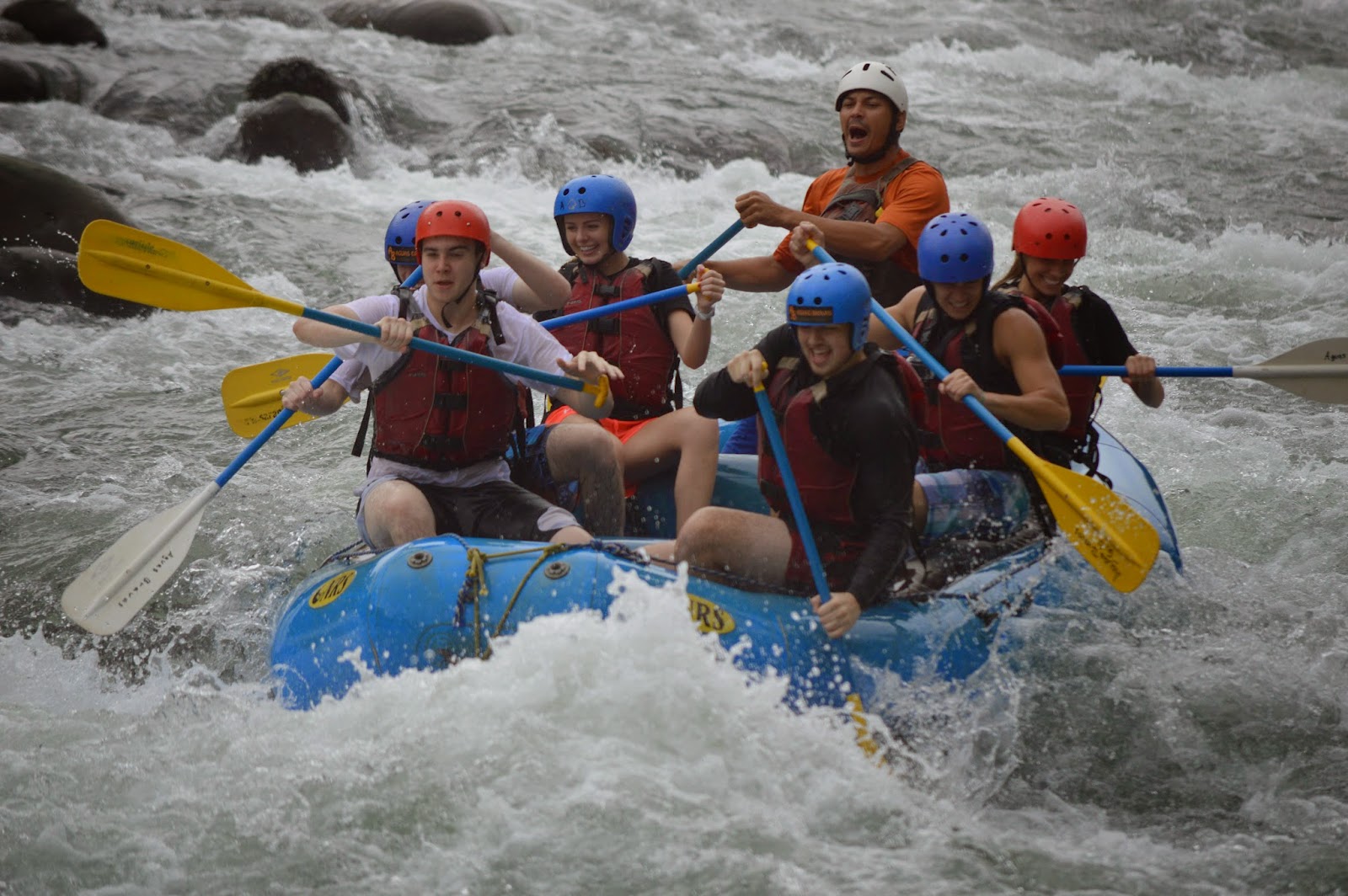
Finally, this class was just plain fun.  This class allowed me to experience some once-in-a-lifetime activities, such as zip lining through the rain forest in Tortuguero, relaxing in natural hot springs with hot water sourcing from a volcano, and whitewater rafting with the beautiful scenery of Costa Rica.  This trip allowed me to learn, have fun, and bond with a group of Bryant University students and faculty for a life changing experience that I will never forget.  This course should be number one on students’ lists when registering for classes.  Sustainability is a topic that compliments business majors.  Sustainability practices are being adopted by a majority of companies in an attempt to create respectable business ethics.  I personally promise that taking this course will change your life and help you stand out when pursuing an internship or job.  Pura Vida! 


BryantMkt421 students learning about sustainability with our tour guide Jonathon.

-Ronald Wagner


Whitewater rafting! #TeamHorsePower

Thursday, April 23, 2015

A Sustainable Future


Costa Rica was an eye opening experience for me and the results were life changing. Prior to the trip my knowledge of sustainability was narrow and limited to just recycling bins; now I can grasp a full understanding of not only the broad aspects of sustainability but the significant impacts it has.


It is important to fully understand the need for and impacts of sustainability practices, especially from a business perspective. Profit-driven businesses often lack sustainable practices. Learning about some of Costa Rica’s businesses and how they coup with the extra efforts despite the additional costs was inspiring to me. I also now make it a point to support local farmers and businesses that source locally, by not only providing them my business over competitors, but also promoting their sustainable efforts through social media.
Learning the importance of sustainable practices through our adventures has inspired me to make small daily changes as well, such as: shorter showers, wearing some clothes twice before washing to decrease load size, using natural light more often than electrical, never wasting food, carpooling, and just always being conscious of things that are on and not being used. Hopefully one day when I have a place of my own I can become even more sustainable and incorporate composting, personal gardening, sorted recycling, and who knows maybe even potential wind or sun powered energy.
I definitely miss the beach and the sun but the places we visited and the people we talked to have changed my perception of sustainability, teaching me lifelong values for a better tomorrow.  
Don’t forget to follow us on Twitter @BryantMKT421 to learn more about our adventures and how you can improve your sustainable practices and preserve our beautiful planet. Pura Vida! - Krysia Syska


Thursday, January 22, 2015

Tirimbina Chocolate Tour

In Sarapiqui, we visited the Tirimbina Rainforest Center where they hold chocolate plantation tours deep in the woods. Upon our arrival, we walked thirty minutes deep into the woods on a suspension bridge that went across the Sarapiqui River (where we went white water rafting earlier that day). This chocolate plantation operates as a nonprofit company and privately owns and protects 350 acres of land. This land is not used for commercial chocolate production; it is reserved with the purpose of educating tourists about traditional coffee cultivating processes. This traditional cultivation is friendly to the environment and aids in the conservation of cacao plants. We spent two hours watching and learning about this traditional process.
The first step in the production of chocolate is to collect the orange fruit shown here, which is known as a pod. The pod is carefully broken open to reveal about 30 beans, which are white in color and slimy in texture. The next few steps are very similar to the coffee production process, as the white pulp is removed from the outside and beans are fermented, dried, and roasted. Fermentation reduces the bitterness of the beans and usually takes seven days, and then the beans are dried in the small drying house shown above. If it is raining the beans are kept under the roof, but when the sun is shining the beans are rolled out into the sun. Naturally the beans are 60% water, but after the drying process they are reduced to 5-10% water. You can tell if the beans are dry by cracking it open; dry beans will be brown and smell like cocoa while beans that are still wet will be purple). Next the beans are roasted in the oven in order to remove bacteria, get any remaining water out, make the shell easier to remove, and develop a better smell. Once the shell is removed, the bean becomes known as a nib.


Next comes the grinding process. We saw Giovanni grind the cocoa beans by hand using a mortar and pestle in the traditional fashion, but commercial chocolate producers will use machines to grind the
beans much finer. The grinding process removes the fat from the cocoa beans and creates a gooey mess. After the cocoa is ground and turned into cocoa liquor, there are two different production options. In order to make chocolate bars, cocoa liquor is refined, sugar is added, then conching and tempering occur. Conching is the process of mixing the cocoa for 72 hours to make it smooth. Tempering is when chocolate is heated to 45 Celsius, mixed to melt it completely, then lowered to 32 Celsius so that cocoa butter will crystallize and become shiny. The chocolate is put into a mold to harden and becomes a chocolate bar. The other production option includes pressing the cocoa liquor to create cocoa butter, which has multiple uses, and a cocoa presscake. The presscake is ground and turned into cocoa powder, which can be used to make cookies, cake, ice cream, and drinks.

Fun Facts
- Before 1519, cocoa powder was mixed with vanilla, chili, and corn to make a thick and spicy chocolate drink. In 1519, nuns brought sugar and cinnamon to Central America and revolutionized the chocolate industry.
- Cocoa stimulates serotonin production in the brain and makes your happier.
- The chocolate bar was created in 1847 but did not sell well until the industrial revolution because it was too grainy when ground by hand.
- Cocoa seeds used to be used as currency. A tomato cost 1 bean, an avocado cost 3 beans, a slave cost 100 beans, and a turkey cost 200 beans.


- Kasey Mazza (@kaseymazza)

Tuesday, January 20, 2015

Mountain Paradise Hotel

Arenal was discovered as a very tranquil area and it is one of the safest destinations in Costa Rica. La Fortuna, Arenal is known for their volcano, which is located in Costa Rica's northern lowlands.  The volcano has an unavoidable and beautiful presence when you are traveling in Arenal.  This place is amazing and I definitely recommend people to travel here.  The hotel that we stayed in was called Mountain Paradise Hotel and it is located near the Arenal Volcano.  The hotel received four leaves rating for their ecological sustainable hotel and is known for their excellent restaurants, which are Arenal Koita Restaurant and the Ave del Paraiso Restaurant.

Arenal Koita Restaurant 
Ave del Paraiso Restaurant


When we got to the hotel we met up with Esteban our tour guide.  He worked for 11 years as a natural tour guide and talked about the different projects that the hotel provides to public schools in Arenal.   Some of the projects that they do with the kids are creating recycling projects, bringing kids to the hotel and giving them a tour of their ecological sustainable hotel, and also purchasing trees to reforest the land.  The reason why Mountain Paradise Hotel does these projects with the kids is because they want to teach the importance of recycling and how beneficial it is to the planet.  I think it is a great idea that they are providing these projects to the students because they are the future and by teaching them about recycling they can not only improve their lifestyle, but also teach their friends and family as well.  It is by law that in Costa Rica all hotels have to be eco-tourism.  Mountain Paradise Hotel keeps their hotel green by recycling, turning off heaters at night, and electricity is run by solar panel and hydroelectric.  Since there is a lot of humidity and rain (6m of water a year) in Arenal, the hotel does not need to use chemical often to keep the pool clean.  Also they get their food from local farmers, which make this hotel sustainable. 


The room that I stayed in was beautiful and also the shower in the bathroom was different from the other hotels that we have been too.  They had a waterfall shower and it made you feel like you were in the rainforest and a jacuzzi outside. I wish we were able to stay here for another night, so that we can enjoy what this hotel had to offer. But with our tight schedule we had to get early and travel to more places in Costa Rica.  If you are looking for a nice tranquil area that is also eco-friendly I recommend Mountain Paradise Hotel. 


PURA VIDA!!


** Certification for Sustainable Tourism Program (CST)- This is a product of the Costa Rican Tourism Board (ICT). The CST was designed to differentiate businesses of the tourism sector, based on the degree to which they comply with a sustainable model of natural, cultural and social resource management.


Monday, January 19, 2015

La Quinta

La Quinta
During our stay at La Quinta in Sarapiqui, our class was invited to adhere to sustainable practices that have guided the Inn since its establishment in 1993. Owners Beatriz and Leo transformed a former orange farm that was depleted of its natural vegetation into a regenerative environment suitable for an eco-friendly hotel. La Quinta – translated to “The House” – and its guests strive to co-exist harmoniously with nature.

Sustainability
La Quinta possesses the highest qualification offered by the Costa Rican Tourists Board at the Fifth Leaf Level of the Certification for Sustainable Tourism (CST). The CST is a comprehensive program that categorizes and certifies each tourism company to the degree they comply with the model of sustainable tourism. Out of the four hotels we explored during our trip La Quinta, at the Fifth Leaf Level, is considered the most sustainable by these standards. Beatriz frequently commented on the overwhelming amount of effort needed to achieve this qualification including: great investments in time and money, ability to maintain complete and accurate paperwork to validate claims of sustainability, and community engagement.


ü  Some Efforts Include:
o   Regenerative agriculture à organic farming intended to build soil health
o   Reforestation à restocking existing forests with native plants
o   Bio-digesting facility à collects sewage and harnesses the gas emitted from separating solids and liquids for alternative sources of energy
o   Saltwater pool à avoids using harmful, unnatural chemicals found in traditional chlorine pools
o   Bulb transition à converted traditional $.05 bulbs to long-term, low-voltage bulbs at $10 each for energy conservation

It was very apparent that La Quinta was a life-long investment for Beatriz and Leo’s family. Prior to its establishment Beatriz asserted that, “The idea of La Quinta was more of a dream than a reality.” Her passion for the development of the Inn was very sincere, and after fifteen years the family advanced from one to five Leaves.

                                                             Community
Most qualified participants in the Certification for Sustainable Tourism lack community engagement, a contributing factor to achieving the coveted fifth Leaf Level. La Quinta is unique to the other three hotels in that it heavily relies on the greater community for support. For example, the inclusive package to accommodate guests at La Quinta does not include the price of meals throughout the day. This intention enables guests to explore and buy food from nearby farmers or providers. This increases the volume of exchanges and stimulates the local economy. Further, most organic produce that was not grown on-site at La Quinta was sourced from these local providers as a means of supporting the community. Additionally, La Quinta makes it a priority to employ the citizens of Sarapiqui in order to offer stable job opportunities. La Quinta ventures farther than just employment, and participates in the Happy Schools Program to provide educational opportunity. During the Happy Schools Program, La Quinta sends representatives to seven local schools to educate students on sustainable practices and bio-diversity. Here students are given an educational foundation on what it means to be sustainable and how to make an impact. More simply put, it’s the hotel’s way of giving back. It is these distinguishing factors that separate La Quinta from the two four Leaf hotels, the Hilton Double Tree and Mountain Paradise Hotels.

Ethan Agnello @BryantMKT421